Best HEP Software for Home Health PTs in 2026
An honest comparison of the top home exercise program tools for mobile clinicians.
Disclosure: This article is published by SendHEP, so we obviously have a perspective. We've done our best to present an honest, fair comparison. We'll tell you where we think we shine and where other tools might be a better fit for certain workflows.
If you're a home health PT, you know the challenge: you need to create a professional home exercise program, often from your car between visits, and get it to your client in a format they'll actually use. The right HEP tool can save you significant time while improving the quality of what you deliver.
Here's an honest look at the options available in 2026.
What to Look For in a HEP Tool
Before comparing specific tools, it helps to know what actually matters for home health clinicians. Based on conversations with dozens of PTs, here are the criteria that matter most:
Mobile-first design — Can you build a complete HEP from your phone without it being a painful experience? If the tool was designed for desktop and the mobile version is an afterthought, it will slow you down in the field.
Speed — How long does it take from opening the app to having a shareable HEP? If it takes more than 5 minutes, you'll stop using it on busy days.
Exercise quality — Are the exercises clinically accurate with clear illustrations? Generic clip art or poorly drawn stick figures undermine your credibility with clients.
Delivery options — Can you send a link, generate a PDF, or both? Different clients prefer different formats, and many facilities still want paper documentation.
Pricing — Subscription costs add up, especially when you're paying out of pocket as an individual clinician. The pricing model should make sense for your volume.
Privacy — Does the tool handle client information appropriately? HIPAA compliance matters, even for HEPs.
The Major Players
HEP2Go
HEP2Go has been around for years and offers a large exercise library with video demonstrations. It's web-based and works on both desktop and mobile browsers. The free tier is generous, which makes it popular among students and new grads. The interface shows its age in some areas and can feel clunky on mobile, but the exercise content is solid and the price (free for basic use, paid tiers for more features) is hard to beat for budget-conscious clinicians.
Best for: Clinicians who primarily work from a desktop and want video-based exercises at no cost.
PT Wired / MedBridge HEP
MedBridge offers HEP creation as part of their broader continuing education and patient engagement platform. The exercise library is extensive, with high-quality video and photo content. The main trade-off is cost — MedBridge is a premium subscription ($150–400/year depending on the plan) and HEP is just one piece of a larger product. If you're already paying for MedBridge CE, the HEP feature is a valuable add-on. If you only need exercise programs, you're paying for a lot you won't use.
Best for: Clinicians already subscribed to MedBridge for continuing education who want an integrated HEP tool.
PhysiTrack / PhysiApp
PhysiTrack offers a comprehensive telehealth and exercise prescription platform with outcome tracking, client messaging, and adherence monitoring. It's feature-rich and well-designed, but the pricing reflects that — it's geared toward practices and clinics rather than individual clinicians. The mobile experience is good, and the exercise library includes video content with multiple angles.
Best for: Clinics and practices that want a full-featured patient engagement platform with HEP as one component.
Simple Exercise Handouts (Paper / Word / Canva)
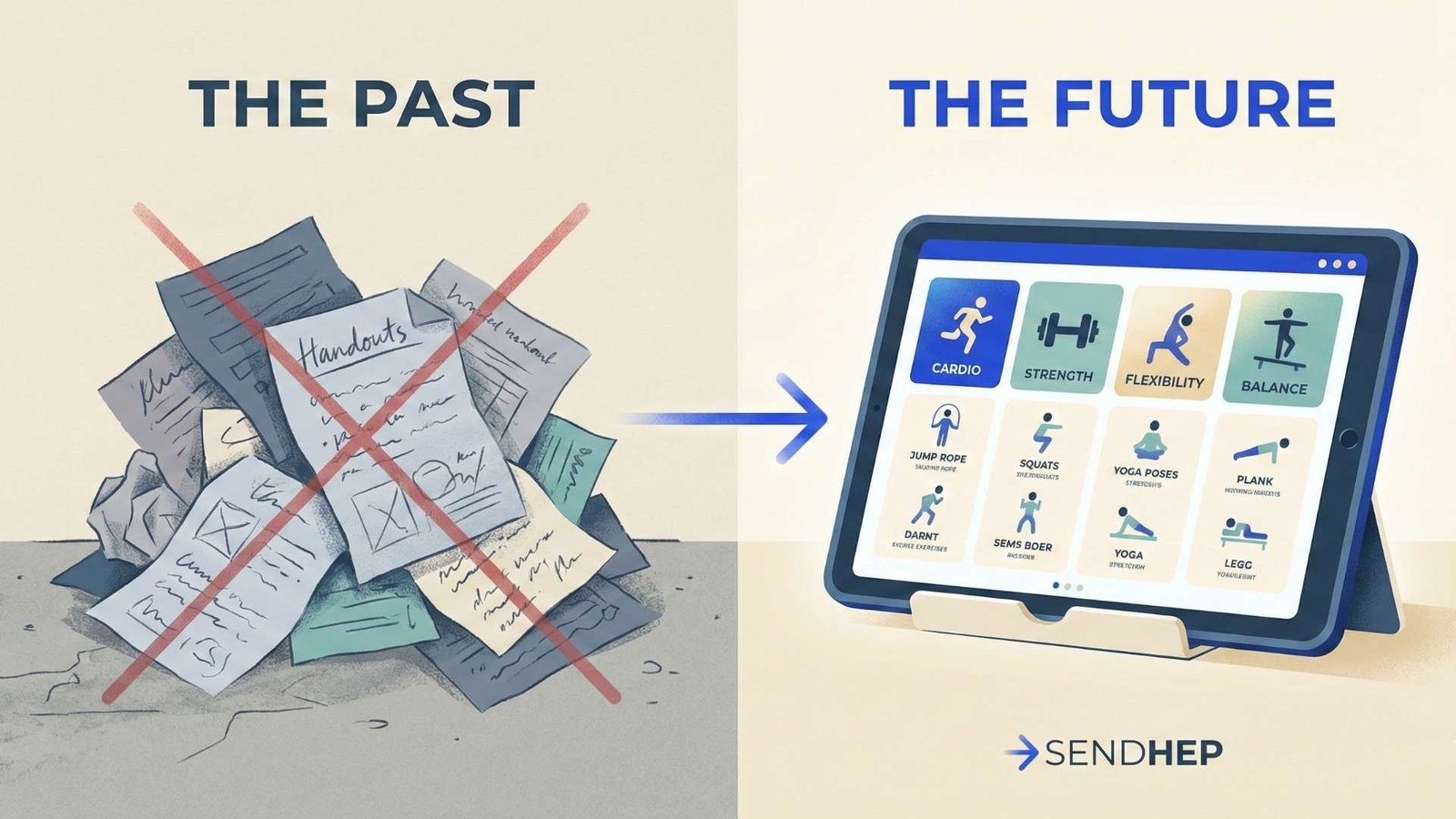
Let's be real — many clinicians are still creating HEPs using printed handout packets, Word documents, or even hand-drawn instructions. This approach costs nothing and requires no learning curve. The downsides are significant though: it's time-consuming, hard to customize, easy to lose, and the quality varies wildly. If your current approach is working and your clients are doing well, there may be no need to change. But if you're spending more time making handouts than you'd like, or if the quality doesn't reflect the care you're providing, a purpose-built tool is worth trying.
Best for: Clinicians with very low volume who prefer physical handouts exclusively.
SendHEP
SendHEP (that's us) was built by a home health PT specifically for the mobile clinician workflow. The core focus is speed and simplicity — create a complete, illustrated HEP in under 2 minutes, entirely from your phone. The exercise library currently includes 88+ exercises with custom illustrations, organized into preset packs based on common diagnoses like post-TKA, fall prevention, rotator cuff, and general strengthening.
Delivery is flexible: generate a shareable link your client can access on their phone (no app download needed) or download a clean PDF for printing. Client data stays on your device for HIPAA compliance — nothing sensitive hits our servers.
Pricing is one-time, not subscription: 10 free programs to start, then lifetime unlimited for $59 during the current founding member period. No monthly fees, no annual renewals. Subscription pricing is planned for the future, but founding members lock in their deal forever.
Honestly, where SendHEP is not the best fit: If you need video exercises (we use illustrated images, not video), if you need a full telehealth/patient engagement platform, or if you need integration with your EMR, you may want one of the more comprehensive tools above. SendHEP does one thing — exercise program creation and delivery — and focuses on doing that exceptionally well and fast.
Best for: Home health and mobile clinicians who want the fastest possible HEP creation on their phone, without subscription costs.
The Bottom Line
There's no single "best" HEP tool — it depends on your workflow, budget, and what features matter to you. If you're a home health PT who values speed and simplicity and doesn't want another subscription, SendHEP is worth trying (your first 10 programs are free, so there's nothing to lose). If you need a comprehensive platform with video, telehealth, and outcome tracking, tools like PhysiTrack or MedBridge may be a better fit despite the higher cost.
The worst option is no HEP tool at all — your clients deserve clear, professional exercise programs that they can actually follow.