Best Home Exercises After Total Knee Replacement
A phase-by-phase guide to post-TKA home exercise programming, from week one through full recovery.
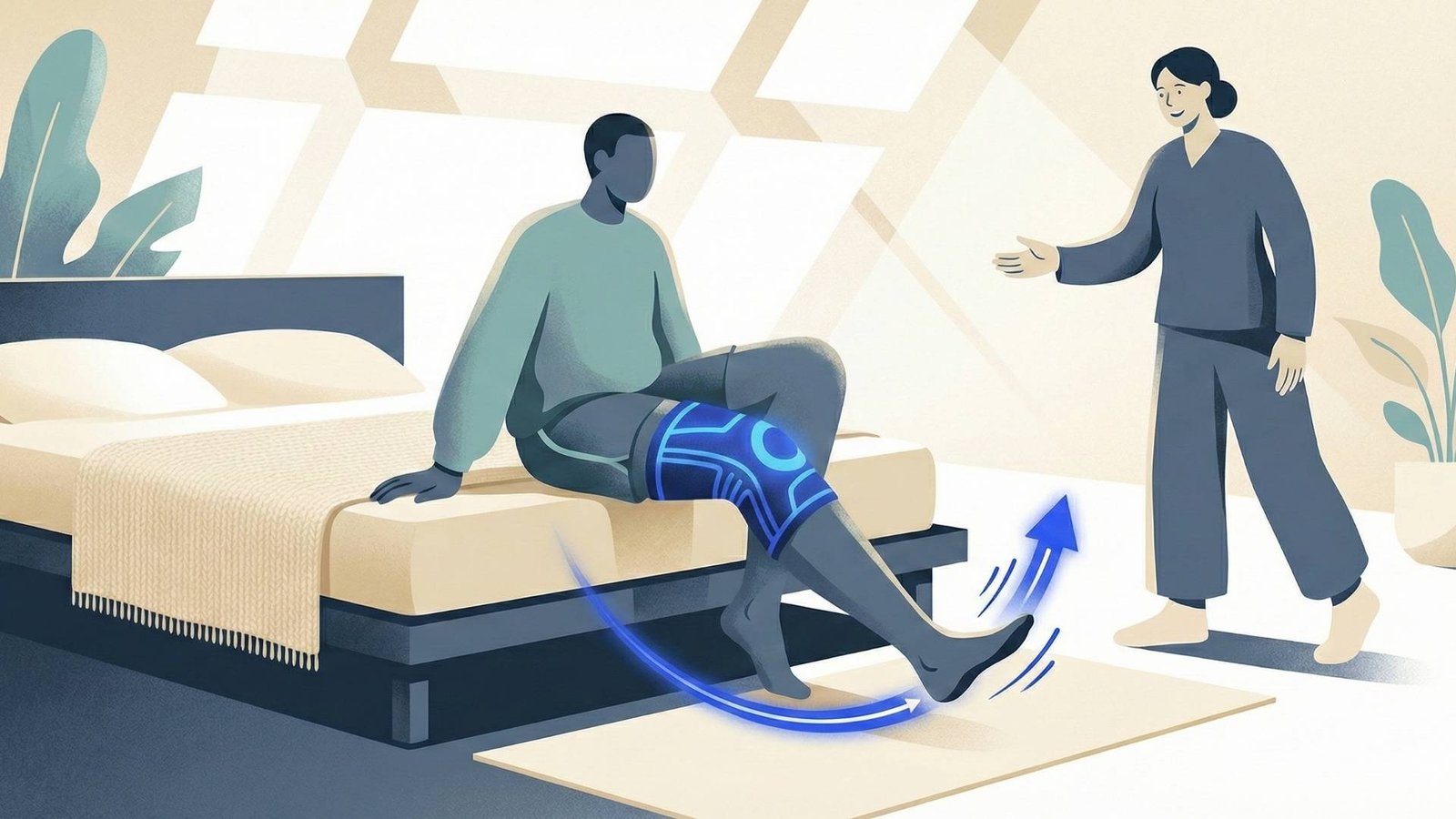
Total knee replacement (TKA) is one of the most common orthopedic surgeries performed today, with over 800,000 procedures done annually in the United States. While the surgery itself has become highly refined, recovery outcomes depend heavily on what happens at home between therapy visits. A well-designed home exercise program is arguably the single most important factor in achieving full range of motion, functional strength, and a return to the activities your clients care about.
As a home health or outpatient PT, your HEP is what bridges the gap between your visits. This guide breaks down the most effective post-TKA home exercises by recovery phase, with clinical reasoning for each.
Phase 1: Acute Recovery (Weeks 1–2)
The primary goals during the first two weeks are pain management, edema control, and restoring basic knee mobility. Your clients will be dealing with significant post-surgical swelling and guarding, so exercises should be gentle and focused on preventing complications like blood clots and excessive stiffness.
Key Exercises
Ankle Pumps — These should be performed every 1–2 hours while awake during the first week. Beyond promoting circulation and reducing DVT risk, ankle pumps give clients a sense of agency during a period when they feel limited. Instruct 20–30 repetitions per session.
Quad Sets — Isometric quadriceps activation is critical from day one. Many clients lose the ability to perform a straight leg raise in the first few days post-op due to quad inhibition. Consistent quad sets help restore the neural connection faster. Cue "push the back of your knee down into the bed" and hold for 5–10 seconds.
Heel Slides — The cornerstone of early ROM recovery. Gravity-assisted heel slides in supine allow clients to work toward flexion in a pain-controlled range. Aim for 10–15 repetitions, progressing range as tolerated. A pillowcase or towel under the heel can reduce friction and make the motion smoother.
Straight Leg Raises (SLR) — Once quad activation is sufficient, add SLRs to restore functional leg control. If your client cannot perform an SLR without a quad lag, continue emphasizing quad sets before progressing.
Phase 2: Early Strengthening (Weeks 3–6)
By week three, acute swelling should be subsiding and your client should have at least 90 degrees of flexion. The focus shifts to building functional strength and improving gait mechanics. This is where a clear, progressive HEP makes the biggest difference.
Key Exercises
Short Arc Quads (SAQ) — Place a bolster under the knee and have the client extend from approximately 40 degrees to full extension. This isolates the terminal range of quadriceps strength that's essential for stair negotiation and walking without a limp.
Long Arc Quads (LAQ) — Seated knee extension through the full available range. Start without resistance and progress to ankle weights as strength allows. This is a critical bridge to functional activities like sit-to-stand.
Sit-to-Stand — Transitioning from a therapeutic exercise to a functional movement. Start from a raised surface (add firm pillows to the chair) and progress to standard chair height. Focus on equal weight-bearing through both legs, which many clients will avoid due to pain or habit.
Standing Hip Abduction — Lateral hip strength is often overlooked in TKA rehab but is essential for normalized gait and single-leg stability. Use a chair or counter for balance support initially.
Phase 3: Functional Progression (Weeks 6–12)
By this phase, most clients should have 110+ degrees of flexion and be ambulating with minimal or no assistive device on level surfaces. The HEP should now target endurance, balance, and sport-or-activity-specific preparation.
Key Exercises
Step-Ups and Step-Downs — Start with a 4–6 inch step and progress height as tolerated. Eccentric step-downs are particularly valuable for building the quad control needed for confident stair descent. Cue slow, controlled lowering.
Wall Squats / Mini-Squats — Closed-chain strengthening that mimics daily functional demands. Progress from partial range wall squats to freestanding mini-squats as strength and confidence improve.
Single Leg Stance — Balance training becomes increasingly important as clients progress toward full community ambulation. Start with fingertip support on a counter, progress to unsupported, and eventually add unstable surfaces or dual-task challenges.
Heel Raises — Calf and ankle strength supports overall lower extremity function and gait quality. Supported heel raises progressing to unsupported builds both strength and proprioceptive control.
Programming Tips
When building your post-TKA HEP, keep these clinical principles in mind. First, ROM exercises should be performed multiple times daily, especially in the first 6 weeks — the window for gaining knee flexion closes progressively. Second, strengthening exercises are best done once daily with adequate rest between sessions to allow tissue adaptation. Third, progress based on quality, not just quantity — a quad set with a visible VMO contraction is worth more than 50 reps of barely trying.
Finally, remember that adherence is the limiting factor for most clients. A home exercise program that's too long or too complex simply won't get done. Prioritize the 4–6 most important exercises for each phase, include clear illustrations or photos, and communicate the "why" behind each exercise.
Send Better TKA Programs, Faster
Building post-TKA home exercise programs doesn't have to mean scribbling on photocopied handouts. With SendHEP, you can build a complete, illustrated HEP in under 2 minutes — including exercises like quad sets, heel slides, SAQs, and all the progressions your client needs. Send it as a shareable link or a clean PDF, right from your phone.